
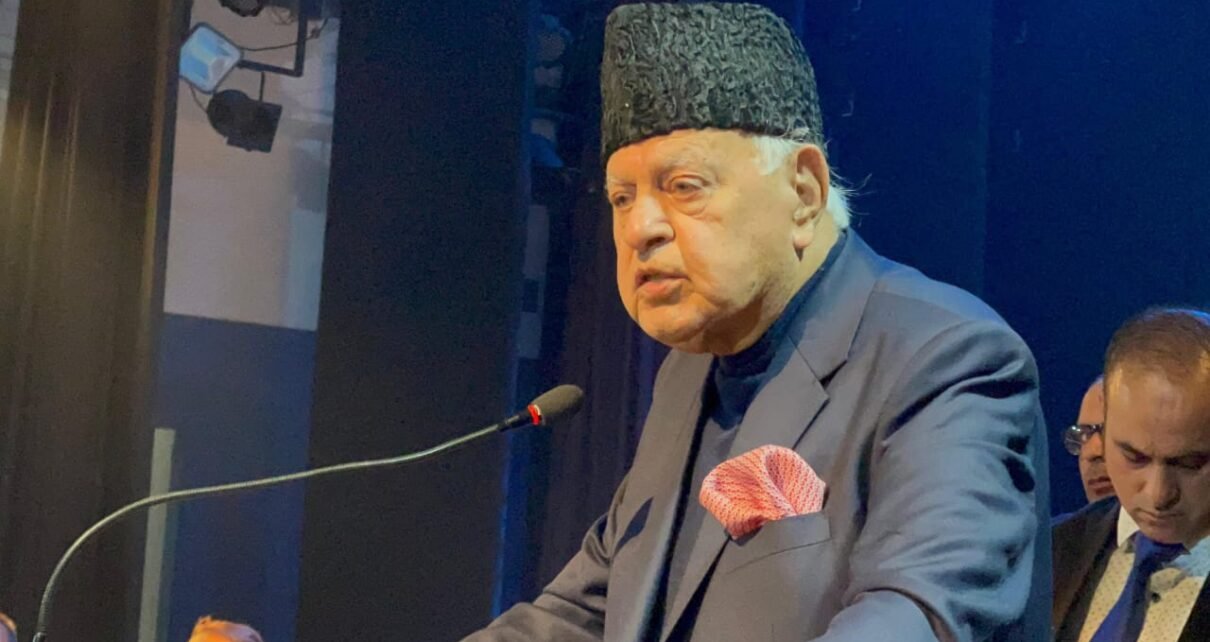
JAMMU — A Jammu court on Friday rejected the bail plea of Kamal Singh Jamwal, accused in the alleged attempt-to-murder case involving former Jammu and Kashmir Chief Minister and National Conference president Farooq Abdullah in March.
Denying the bail to 65-year-old Jamwal, Principal Sessions Judge Jammu R N Watal cited the gravity of the allegations, the larger public interest and the possibility of the offence being repeated.
Abdullah had a miraculous escape when Jamwal allegedly opened fire on him after coming from behind while he was leaving a marriage function at Royal Park Banquet Hall in the Greater Kailash area of Jammu on March 11. A revolver used in the crime was recovered from the possession of the accused.
On March 14, Jammu and Kashmir police constituted a special investigation team under the supervision of a deputy inspector general of police to probe the case.
“Attack on public figure or Ex-CM Dr Farooq Abdullah is viewed not just as a crime against an individual but as an assault on public order and democratic stability. It carries a profound societal impact, threatening public order and the rule of law,” the judge said in his 20-page order.
The court said the investigators alleged that the accused fired a revolver at Abdullah from close range with the intention of killing him, but the shot missed its target.
Police subsequently registered the case, seized the alleged weapon along with five live and a fired cartridge case, and constituted a SIT to conduct a detailed probe.
Quoting the prosecution, the court said the investigation uncovered evidence suggesting the accused had harboured resentment against Abdullah for nearly two decades over the migration of Kashmiri Hindus and the loss of his family’s property in the valley.
The SIT cited handwritten notes allegedly recovered during searches, forensic examination of those writings, electronic evidence and witness statements to contend that the attack was premeditated and driven by vengeance.
It said the alleged act, if successful, could have been catastrophic for public order and there would have been large-scale violence in the whole Union territory as Abdullah is having mass support not only in the valley but also in parts of Jammu region.
“The congenial atmosphere of J&K as is prevailing at present having good influx of tourists would have been adversely affected and also leading to national/international ramifications,” the order said.
In a significant observation, the court rejected the accused’s attempt to attribute the Kashmir turmoil solely to Abdullah.
Observing that “attributing the turmoil in the Valley to Abdullah only… is inappropriate,” the court said the unrest was “abetted and aided by the enemy country that trained a section of misguided youths who thereafter resorted to militancy in the State and destroyed peace atmosphere and centuries old communal harmony.” It said while the accused may have been distressed by migration and the loss of his property in Kashmir, “that does not mean that he should have resorted to such extreme step of attempting to murder” a public figure.
Seeking bail, the defence argued that the accused suffers from neurological and psychiatric ailments, has been undergoing treatment for several years and requires specialised medical care that cannot adequately be provided in custody.
It submitted that he had attended the wedding as an invitee, consumed alcohol and merely wanted to meet Abdullah and have a photograph taken with him.
The defence denied any intention to attack the former chief minister and maintained that the accused had been falsely implicated. It also argued that the investigation was substantially complete and that the accused was willing to abide by any conditions imposed by the court.
The prosecution opposed the plea, contending that the allegations involved an attempt on the life of a prominent public figure and therefore carried far-reaching consequences for public order and security.
It argued that the accused could influence witnesses, tamper with evidence or repeat the offence if enlarged on bail, adding that adequate medical facilities were available in jail.
While discussing the principles governing bail, the court reiterated that although personal liberty is protected under Article 21 of the Constitution, courts must also weigh the gravity of the offence, the nature of evidence, the possibility of witness intimidation or evidence tampering, the likelihood of the accused absconding and the broader interests of society before exercising judicial discretion.
The court observed that an alleged attack on a former Chief Minister cannot be viewed as an ordinary criminal offence, noting that such incidents have the potential to disturb public order and democratic stability.
It further observed that the prosecution material suggested a planned act motivated by long-standing animosity and that, at the present stage, those allegations could not be ignored while deciding the bail application.
Rejecting the defence plea based on alleged mental illness, the court held that no cogent medical material had been produced to establish that the accused suffered from a mental disorder warranting release on bail.
It said the questions relating to legal insanity or criminal responsibility are matters to be examined during the course of the trial and not at the stage of deciding bail.
The court also noted that psychiatric treatment could be provided to the accused while in judicial custody.
The court cited the alleged heinous nature of the offence, the severity of the prescribed punishment, the larger interest of society, the possibility of repetition of the alleged act and the apprehension of the accused fleeing from justice as reasons for declining relief. — (PTI)