
SRINAGAR — The Jammu and Kashmir Government has notified the J&K Circular Economy Policy, 2026, aimed at improving waste management, promoting resource recovery and advancing ecological sustainability across the Union Territory.
The Chief Minister’s Office announced the development in a post on X, stating that the policy marks a significant step towards green growth and sustainable development.
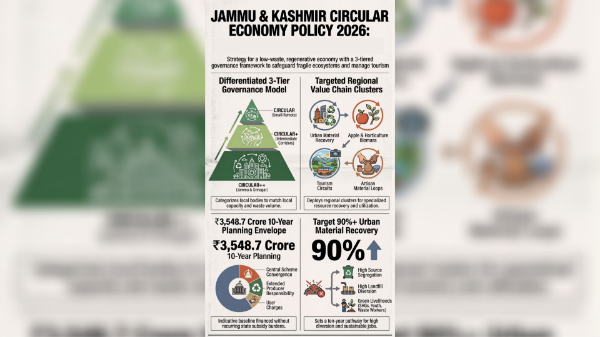
Recognising the region’s diverse geography and settlement patterns, the policy envisages decentralised waste processing in remote areas, hub-and-spoke logistics across intermediate corridors and advanced circular economy systems in major urban centres, including Jammu and Srinagar.
The policy covers a wide range of waste streams, including municipal solid waste, food and wet waste, tourism-related waste, horticulture and agricultural biomass, packaging waste, construction and demolition waste, e-waste and wastewater. It also focuses on resource recovery through repair and refurbishment, alongside material cycles linked to wool and handicrafts.
To address these varied requirements, the policy introduces a three-tier framework — Circular, Circular+ and Circular++ — to tailor waste management, recycling, resource recovery and wastewater reuse systems to the needs and capacities of local bodies across J&K.
The roadmap also envisages the development of regional clusters to overcome logistical and terrain-related challenges. These clusters are expected to facilitate waste aggregation, improve transportation efficiency and make processing of different waste streams more viable.
The policy will be supported through convergence with Central government schemes, Extended Producer Responsibility (EPR) mechanisms and public-private partnership (PPP) models.
According to the Chief Minister’s Office, the framework is intended to improve resource efficiency, support sustainable urban and rural growth and create new livelihood opportunities in the green economy. — (KIMS)