
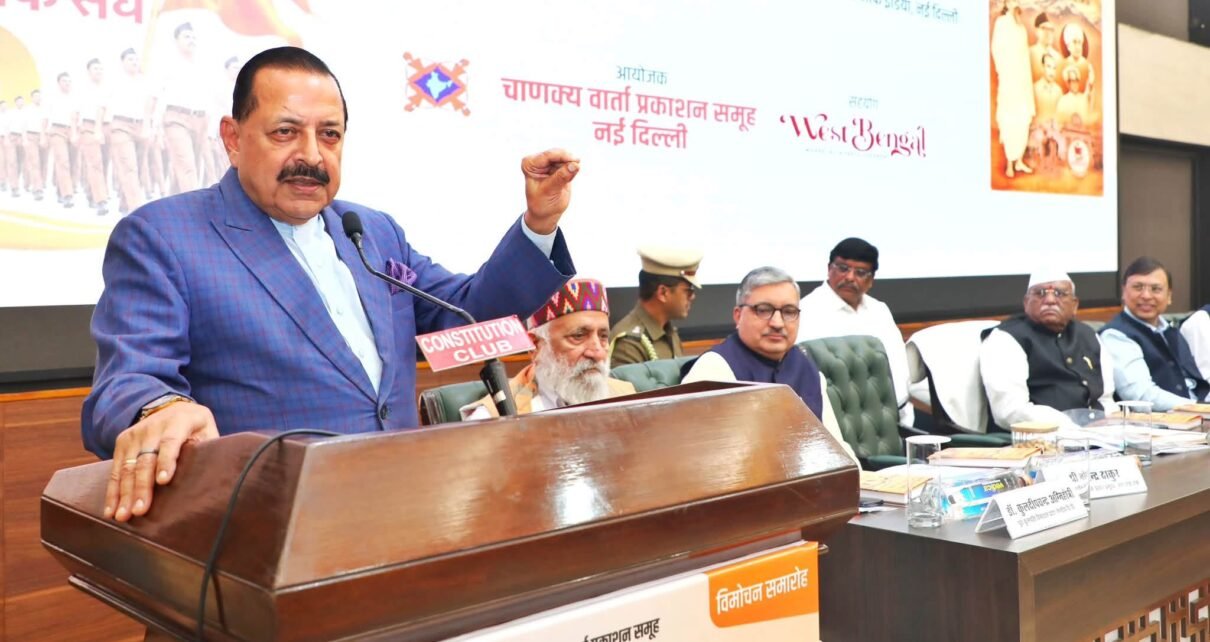
JAMMU — Union Minister Dr Jitendra Singh on Thursday said six decisions taken by former Prime Minister Jawaharlal Nehru, including the 1947 ceasefire, taking the Kashmir issue to the United Nations and Article 370, had shaped Jammu and Kashmir’s prolonged political challenges and left a lasting burden on the country.
Addressing the release of the book “Jammu-Kashmir: Chunautiya aur Sangh”, authored by senior journalist Ramesh Gupta and edited by senior journalist Dhirendra Mishra, Singh said the Rashtriya Swayamsevak Sangh (RSS) had maintained a strong ideological presence in the region since the pre-Independence era, despite limited electoral success.
In a post on X, Singh said difficult circumstances in Jammu and Kashmir had prevented many people ideologically aligned with the Sangh from openly associating with the organisation due to apprehensions about possible consequences in employment, business and public life.
He said the organisation’s strength was not reflected merely in numbers but in its ability to sustain its ideological commitment despite adverse circumstances.
Listing six decisions of Nehru, Singh cited the unilateral ceasefire in 1947, taking the Kashmir issue to the United Nations, Article 370, the Indus Waters Treaty, India’s China policy and the Non-Aligned Movement, saying these had contributed to a prolonged period of uncertainty in Jammu and Kashmir.
He also highlighted the RSS’s role in providing relief during Partition, rehabilitating refugees, assisting displaced families and participating in nationalist movements, saying its contribution formed an inseparable part of the region’s history.
Singh said separatist violence may have declined, but the ideological battle was far from over, asserting that nationalist forces would have to continue their struggle.
He further said that the only outstanding issue between India and Pakistan was the retrieval of Pakistan-occupied Jammu and Kashmir (PoJK). — (KIMS)