


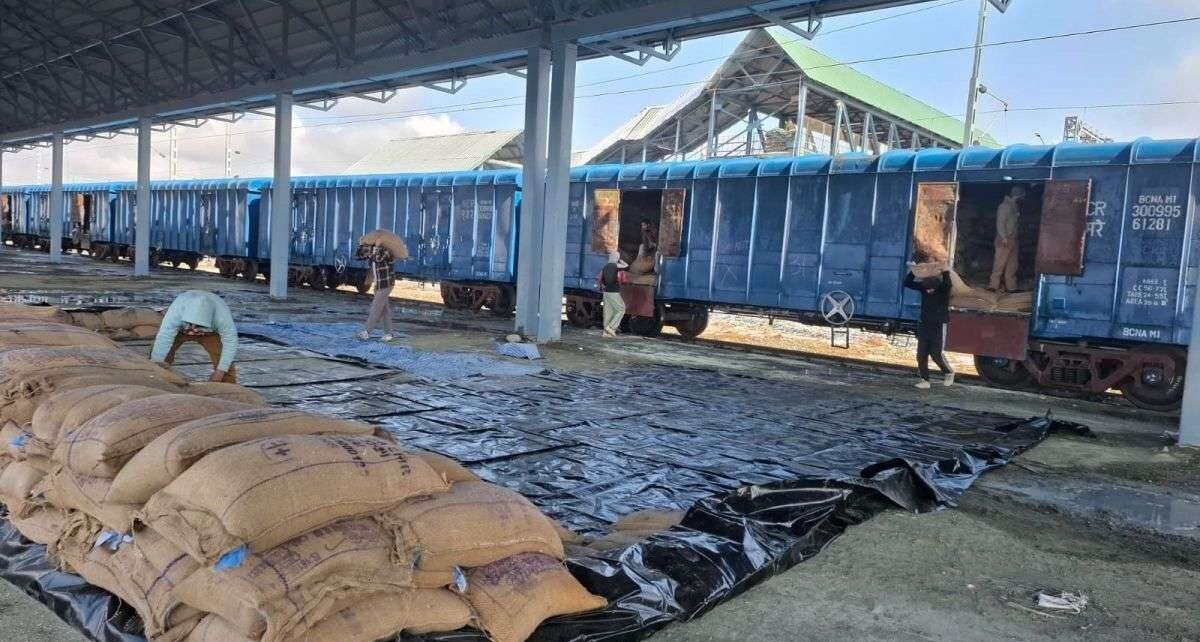
NEW DELHI — A little over seven months after the Kashmir line became fully operational, the Railways have facilitated the arrival of the first-ever full railway rake of foodgrains in the Valley.
On Thursday, the 42-wagon train laden with rice arrived at the Anantnag goods shed from Sangrur rail terminal in Punjab.
Northern Railways’ Chief Public Relations Officer Himanshu Shekhar Upadhyay said the unloading of the train was delayed due to snowfall in Kashmir on Friday. “The unloading of rice was completed on Saturday. The total weight of foodgrain on the train was 2,600 tonnes – equivalent to transporting 100 trucks full of rice. Railways will soon be transporting other commodities, apart from cement and foodgrains, in the region. We are focusing on diversifying our freight basket,” said Upadhyay.
Earlier, in December 2025, a mini foodgrain freight train with 21 wagons and carrying 1,384 tonnes reached the Anantnag goods terminal. The train, dispatched from Ajit Wal Railway Station in Punjab, marked the first bulk rail-based foodgrain supply to Kashmir via train.
“This first ever full rake of rice movement was possible due to the coordination between the Railways, Food Corporation of India and the state administration. The consignment was loaded at the Sangrur rail terminal in Punjab on January 21 and reached Anantnag in less than 24 hours. It has environmental benefits such as reducing reliance on heavy truck traffic via the national highway and providing all weather transportation,” said Upadhyay.
The movement of freight trains to Kashmir began with the supply of 1,380 metric tonnes of cement in August 2025 following orders placed by private entities engaged in various construction projects in the region.
The 272-km Udhampur-Srinagar-Baramula Rail Link (USBRL), or Kashmir line, became fully operational on June 6, 2025, when Prime Minister Narendra Modi inaugurated 63-km Katra-Sangaldan section of USBRL, marking the completion of a project to link the Valley to the rest of the country, which was first initiated 42 years ago.
While different stretches of the project were made operational earlier in phases, the trickiest one was the 111-km Katra-Banihal section. This includes India’s longest operational transportation tunnel, T-50, running to 12.77 km; the world’s highest railway arch bridge at 359 metres above the sea floor (the Chenab Bridge); and the first cable-stayed bridge of the Railways (the Anji Bridge).
Currently, Vande Bharat is running from Katra to Srinagar while local trains are operational in the USBRL’s 184-km stretch between Sangaldan in Jammu’s Ramban district and Kashmir’s Baramulla.
While coal accounts for more than 50% of the total freight loading of the Railways, foodgrains constitute another important bulk commodity, as their transportation supports critical sectors of the economy and ensures food security for the population. It contributes nearly 5% percent to the Railways’ freight earnings.
Of the total domestic transportation of foodgrains, over 80% is carried by the Railways, with the remaining share transported through roadways and waterways. In the financial year 2024-25 (up to February 2025), of the total transportation of 381 lakh metric tonnes (LMT) of foodgrains, almost 306 LMT was moved by the Railways. — (The Indian Express)