
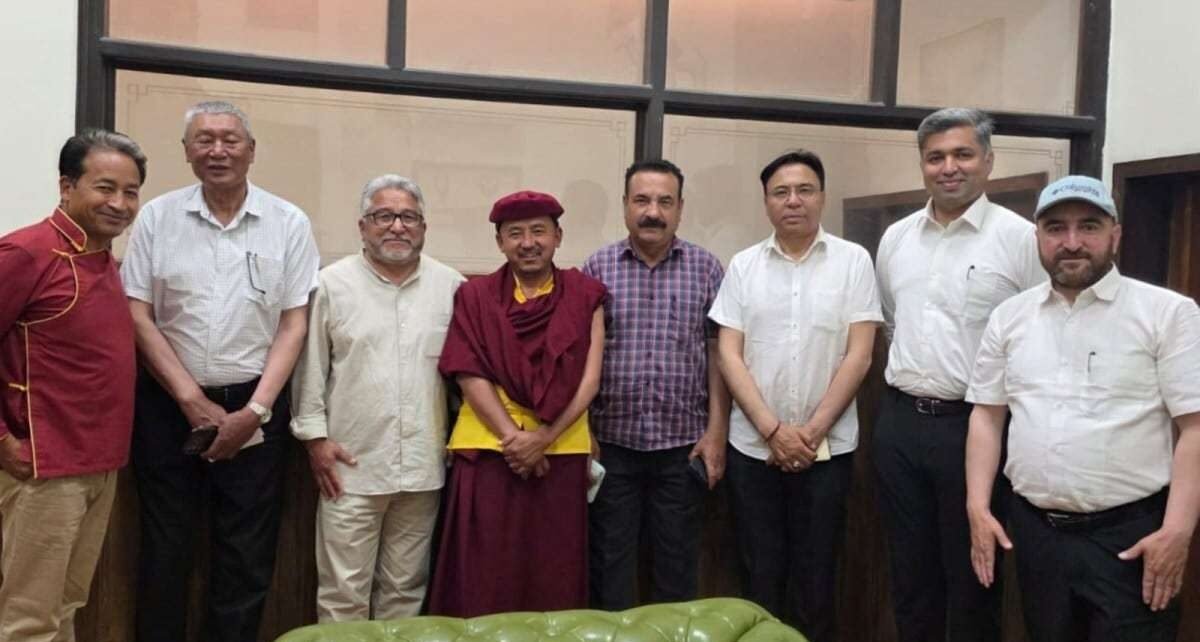
NEW DELHI/SRINAGAR — In a breakthrough after months of protests, negotiations, and political mobilisation in Ladakh, representatives of the Apex Body, Leh (ABL) and Kargil Democratic Alliance (KDA) on Friday said they had reached “in-principle understanding” with the Centre on “restoring democracy in Ladakh” and providing “Constitutional safeguards on the lines of Article 371 A, F, and G”, following talks with senior Union Home Ministry officials.
These are provisions that are applicable in states such as Nagaland, Sikkim, and Mizoram. It also signals that the Ladakh civil society groups have agreed to compromise on their demand for Sixth Schedule status.
The understanding emerged during a meeting between the sub-committee on the Ladakh issue involving senior members of the ABL and KDA and senior officials of the Union Home Ministry. The sub-committee is tasked with preparing the groundwork for a larger high-level meeting of the High Powered Committee to be chaired later by Minister of State for Home Nityanand Rai.
“In this model, the legislative, executive and financial powers will rest with elected representatives through a Union Territory-level legislative body,” the ABL and KDA said in a statement.
It added: “All bureaucrats of the UT, including the Chief Secretary, will come under the executive head of the UT level elected body (proposed to be Chief Minister).”
Sources said the government has refused to grant statehood or even UT-with-legislature status to Ladakh. However, it has agreed to give it an administrative system that will be akin to the latter and call the head of this administration the “chief minister”.
ABL co-chair Chhering Dorje Lakruk said, “A broad agreement has been reached on having a representative administration. It would have legislative and financial powers. The bureaucrats will work under the authority of the chief minister. Land, jobs and culture would be protected under Article 371. Finer details will be worked out in further meetings.”
This will effectively be a better arrangement than Jammu & Kashmir, where services continue to be under the Lieutenant Governor, leading to a dual power structure where the ministries are under the Chief Minister while the transfer and posting of secretaries are under the L-G.
Why Ladakh cannot be a state right now
The statement from ABL and KDA said both sides had held “detailed and constructive deliberations” on the “future administrative and political framework of Ladakh”, during which the two outfits reiterated the “long-standing aspirations of the people of Ladakh regarding the restoration of democracy, constitutional safeguards, and the demand for Statehood and Sixth Schedule protections”.
The two organisations said the discussions reflected a “shared commitment of all stakeholders towards an inclusive and sustainable governance framework for the region”.
On the issue of statehood, the statement said MHA officials had explained that “the only reason why Ladakh cannot be made a state at the moment is that it currently lacks adequate revenue generation to meet the revenue expenditures like salaries of employees”. “However, this setup will lead Ladakh towards full statehood as and when it meets the revenue criteria,” it added.
This could be a rather long shot for a region like Ladakh. J&K barely generates around 15% of its budget with its own revenues. When it was a full state, and included Ladakh, it generated around 10% of its budget on its own revenue. The rest was met by central grants.
The ABL and KDA said they would continue consultations with the Centre to “work out the finer operational details with the MHA in consultation with legal and constitutional experts”.
On the importance of Friday’s discussions, Ladakh Chief Secretary Ashish Kundra said the Central government outlined the measures that had been taken up over the last couple of years for augmenting employment opportunities and reservation to local communities, among other things.
“Now the time was ripe for moving towards the process of creating the right institutional frameworks for democratic representation (for Ladakh) and within that, Article 371 was brought up for discussion,” Kundra said.
Substantive move forward
Friday’s development marks the most substantive movement yet on Ladakh’s political demands since the region was separated from the erstwhile state of J&K and made a Union Territory without a legislature in 2019.
While the move was initially welcomed by many in Leh, concerns steadily grew in both Leh and Kargil over the absence of Constitutional safeguards protecting land, jobs and cultural identity, as well as the concentration of administrative authority in the bureaucracy.
The ABL and KDA — umbrella groupings representing civil society, political and religious organisations from Leh and Kargil respectively — have since jointly spearheaded an agitation demanding statehood, Sixth Schedule status, constitutional protections, a separate Public Service Commission and enhanced parliamentary representation for Ladakh.
The movement gained national prominence through activist Sonam Wangchuk, who was also present in Friday’s meeting. Wangchuk had led fasts and public campaigns pressing the Centre to fulfil assurances made after the 2019 reorganisation of Jammu and Kashmir.
Last year, Wangchuk was arrested under the stringent National Security Act after a protest in Leh demanding the Sixth Schedule turned violent, leading to the killing of four youths in police firing. Wangchuk was released recently from Jodhpur jail, following which the Centre scheduled the meeting that happened on Friday. — (The Indian Express)