
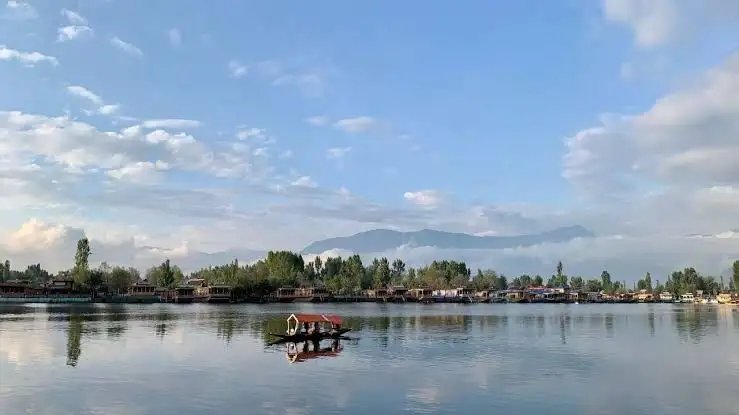
JAMMU — The Comptroller and Auditor General (CAG) has flagged significant spatio-temporal changes in land use and water cover of the iconic Dal lake, pointing to a shrinkage of the water body from 15.40 square kilometres in 2007 to 12.91 square kilometres in 2020, registering a decline of 10.15 per cent in 13 years.
The CAG recommended a robust lake management policy to ensure effective functioning and upgrade of sewage treatment plants (STPs) to ensure proper treatment of sewage and solid waste entering the lake.
“It may be seen from data that during 2007-2020, there was a decrease from 15.40 to 12.91 square kilometres (10.15 per cent) in the water body with (respect to) submerged vegetation and open water of the lake, while there was increase in other land uses such as floating vegetation from 5.262 to 6.796 square kilometres (6.23 per cent), crop land and plantation from 2.29 to 2.85 square kilometres (2.27 per cent), and built-up from 0.743 to 1.025 square kilometres (1.15 per cent),” the report said.
The CAG report on conservation and management of lakes in the Union Territory for the year ended March 31, 2024, said there was a decrease in vacant land with or without vegetation from 0.40 to 0.36 square kilometres (0.17 per cent) due to dredging of some acquired land. The decrease in open water area was at the cost of other land use changes.
The CAG said the shifting land use pattern reflects growing pressure on the lake ecosystem, with shrinking open water and expanding human-induced activities altering its ecological balance.
The CAG observed that no concrete measures were taken by the Lakes Conservation and Management Authority (LC&MA) to regulate land use, nor were reasons for such changes adequately analysed.
Audit findings attributed the deterioration to non-acquisition of land from Dal lake dwellers, malfunctioning STPs, failure to arrest pollution inflows, improper de-weeding, and weak monitoring.
As a result, the inflow of nutrients increased, leading to excessive weed growth and further shrinkage of the lake’s open water area, the report said, adding that encroachments in areas such as Mir Behri, Lati Mohalla and Nandapora contributed to expansion of floating gardens and habitation.
The audit also flagged serious deficiencies in the implementation of conservation programmes under the National Lake Conservation Programme (NLCP) and the Prime Minister’s Reconstruction Programme (PMRP).
“Key activities such as installation and upgradation of STPs, solid waste management, sewer networking, relocation of houseboats and hotels, catchment management, and rehabilitation of Dal dwellers were either delayed or inadequately executed,” the report stated.
Despite an expenditure of more than Rs 45 crore on STPs, the audit found that sewage was not treated as per prescribed standards, resulting in continued deterioration of water quality. “Untreated waste from households, houseboats and hotels continued to flow into the lake due to incomplete sewer networks and delays in connecting households and houseboats to treatment systems.”
The report further highlighted underutilisation of funds, ranging between Rs 48.63 crore and Rs 280.68 crore during 2017-22, and pointed to delays caused by stalled board meetings, lack of project management consultants, and failure to prepare detailed project reports for pending works.
Efforts to relocate Dal dwellers and houseboats also fell short, with only a fraction of targeted land and structures acquired and no significant dredging carried out on acquired land. Similarly, shifting of hotels and establishment of effective surveillance mechanisms remained incomplete, it added.
The CAG noted that catchment management works were inadequate, with only four out of 15 identified micro-watersheds taken up, also flagging shortcomings in structural and vegetative measures, training programmes and monitoring systems.
Describing the lake as the “liquid heart” of Srinagar, located at an altitude of 1,583 metres, the audit warned that continued delays and inadequate conservation efforts have hindered restoration of its water expanse and ecological health.
The CAG recommended periodic monitoring of water spread, a robust lake management policy, effective functioning of STPs, improved sewage and solid waste treatment, and expedited implementation of key conservation measures.
It also called for public awareness campaigns to curb unauthorised construction and better monitoring of nutrient inflows into the lake.
The audit said unless systemic gaps in planning, execution and monitoring are addressed, restoration of Dal lake’s shrinking water body would remain a challenge. — (PTI)