
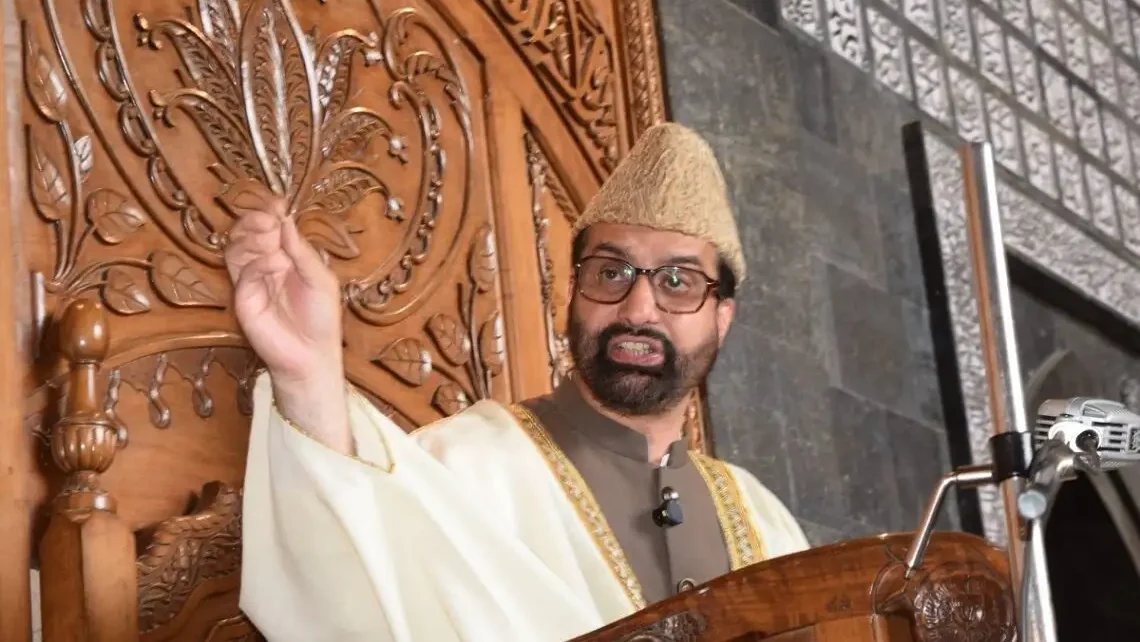
SRINAGAR — Kashmir’s chief cleric Mirwaiz Umar Farooq on Friday said the Nepal tragedy should serve as a warning, and called for urgent protection of the valley’s “fragile ecology” by creating a balance between development and environmental preservation.
Addressing the Friday congregation at the historic Jamia Masjid here, Farooq said the devastation being witnessed in Nepal and across the Himalayan region should deeply concern all.
“These are not isolated events. They are warnings of how vulnerable our mountain ecosystems have become as glaciers collapse.
“We express our heartfelt solidarity with the people of Nepal at this difficult time, and pray for those who have lost their lives, for the safety and early recovery of the many people who remain missing, and for strength and relief for all those affected,” he said.
The Mirwaiz said Jammu and Kashmir is part of the same fragile Himalayan belt.
“We are already seeing more intense rainfall, cloudbursts, flash floods and landslides. Climate change is undoubtedly a major factor, but we must also ask whether our own pattern of development is making the situation more dangerous”.
He said that gifted with the natural beauty of mountains, lakes and rivers, Kashmir attracts tourists and travellers and is a source of sustenance to a large population here.
“But the manner in which we are recklessly exploiting this ecology for commerce and in the name of development is very worrying. Mountains are being cut and blasted for roads, trees are being felled, hotels and buildings are coming up in ecologically sensitive areas and natural drainage channels are being disturbed.
“If this continues without proper scientific and environmental safeguards, we are creating conditions for far greater disasters in the future,” he said.
Equally worrying is the continued encroachment of wetlands, lakes and flood channels, he said.
“I appeal to people not to occupy or build upon these areas. Wetlands are not unused land; they are natural buffers that absorb excess water and protect human settlements,” he added.
Referring to the famous Dal Lake, the Mirwaiz said that its condition tells all how prolonged encroachment, construction and environmental neglect can damage a precious natural system.
“It is shrinking day by day while we look the other way as if it’s no concern of ours,” he said.
He asserted that it is a matter of serious collective responsibility.
“Authorities, planners, businesses and citizens all have to recognise that in a fragile Himalayan region development for infrastructure and tourism carries serious consequences. We have to strike a balance between ecological preservation and human intervention in the name of progress,” he said.
The tragedy in Nepal must be seen as a warning close to home. We too live in the Himalayas. If we continue to disturb the natural balance of our mountains, forests, wetlands and waterways, the consequences may one day be irreversible, he added.
The preacher said that protecting our environment today is not merely about conservation. “It is about protecting lives, homes and the future of our children”. — (PTI)